How much do we remember from listening?
Even though your ears are capable of picking up on so many words, your brain doesn't necessarily process all of them. Most people usually only remember about 17 to 25% of the things they listen to.
What percentage of information do we retain?
After one hour, people retain less than half of the information presented. After one day, people forget more than 70 percent of what was taught in training. After six days, people forget 75 percent of the information in their training.
How many times do we have to hear something to remember it?
Follow Up With Materials to Help Your Audience Retain and Process the Message. Research shows the average prospect needs to hear a message seven times before they take action.
How much do we actually remember?
The original research into short term memory says we can only remember 5 to 9 pieces of information there at any given time, though more recent experiments suggest it may even be as low as 4!
How Do We Remember Things And Why? How Does Our Brain and Memory Work?
Are you more likely to remember stuff you see or stuff you hear?
You see, visual images tend to have more things we instantly associate with them -- for example, a picture of some horses on a farm, instantly calls up images of hay, riding, a barn, a cowboy, etc. and those connections make the information more "memorable" and thus, makes recollection easier and more likely.
What percent of learning is retained?
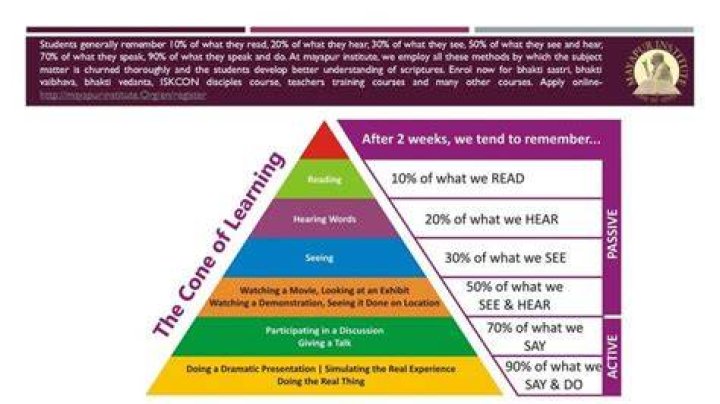
The "learning pyramid", sometimes referred to as the "cone of learning", developed by the National Training Laboratory, suggests that most students only remember about 10% of what they read from textbooks, but retain nearly 90% of what they learn through teaching others.
How much do we forget?
Learners will rapidly lose their memory of learned knowledge in a matter of days or weeks unless the information is consciously reviewed. Some studies suggest that humans forget approx 50% of new information within an hour of learning it. That goes up to an average of 70% within 24 hours.
Is it better to learn by reading or listening?
Speed of Acquiring Knowledge. Some people might wonder whether reading or listening is a faster way to understand the material. Again, it depends on the individual and the complexity of the material. Researchers have found that reading generally is faster than listening.
Is reading better than watching videos?
Reading stories in books and watching stories on video both enhance your brain's imagination capacity. But independent researchers have concluded that reading is contributing much more than watching videos.
What is it called when you remember everything you hear?
Echoic memory is the ultra-short-term memory for things you hear. The brain maintains many types of memories. Echoic memory is part of sensory memory, storing information from the sounds you hear.
Is there a limit to brain memory?
You might have only a few gigabytes of storage space, similar to the space in an iPod or a USB flash drive. Yet neurons combine so that each one helps with many memories at a time, exponentially increasing the brain's memory storage capacity to something closer to around 2.5 petabytes (or a million gigabytes).
How far can most people remember?
Adults can generally recall events from 3–4 years old, with those that have primarily experiential memories beginning around 4.7 years old. Adults who experienced traumatic or abusive early childhoods report a longer period of childhood amnesia, ending around 5–7 years old.
How much do students remember?
In his experiments, he discovered that without any reinforcement or connections to prior knowledge, information is quickly forgotten—roughly 56 percent in one hour, 66 percent after a day, and 75 percent after six days. So what can be done to preserve the hard work of teaching?
What is the lowest form of learning?
The simplest form of learning is nonassociative learning such as habituation and sensitization. These refer to a decrease or an increase in a behavioral response dependent on the number and intensity of stimulus presentations.
What is the highest form of learning?
Creating is the Highest Form of Learning
- You have to learn to create.
- Creativity and Creating are two completely separate things.
- Creating, on the other hand, is a process. It is a learned behavior. ...
- This is good news for humanity!
Do you remember everything you hear?
Chances are, you won't. Researchers at the University of Iowa have found that when it comes to memory, we don't remember things we hear nearly as well as things we see or touch.
Why can't I remember what I just read?
After reading, you may find it almost impossible to retain the information acquired. It may be due to lack of adequate sleep and rest, distractions while reading, poor nutrition, failure to choose the right book, or memory issues such as decay or shallow processing.
How much do we remember from a presentation?
The most generous results we've seen regarding what people remember are as follows: Immediately after the presentation, the audience remembered 50% of what was said. By the next day, the audience remembered 25% A week later, the audience remembered just 10%
Do you remember better when reading out loud?
You are more likely to remember something if you read it out loud, a study from the University of Waterloo has found. A recent Waterloo study found that speaking text aloud helps to get words into long-term memory.
Do eidetic memories exist?
A number of people claim to have eidetic memory, but science has never found a single verifiable case of photographic memory. Eidetic imagery is virtually nonexistent in adults. Most people showing amazing memory abilities use mnemonic strategies, mostly the method of loci.
Is audio or visual information better remembered?
Visual learning outperformed auditory learning in both the immediate post-test condition, as well as in the delayed post-test condition. Overall, our study found that visual learning produced better recall than auditory learning.
How much Einstein used his brain?
Albert Einstein used 100% of his brain as the rest.
Can you pick up a human brain?
It turns out that the human brain is very fragile. It has a consistency somewhat like jello: soft and squishy. Without preservation and chemical hardening you couldn't pick a brain up.